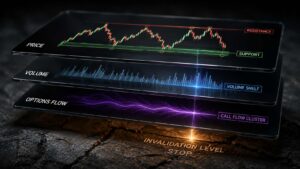
We’ll cover whether today’s pullback in semis is a buy the dip opportunity, the impact on energy stocks after Iran rejected the peace proposal, my whale hunting strategy in an over-extended market and more — Profit Panel starts at 2:30 PM ET
I was talking on a recent Profit Panel about something that doesn’t get nearly enough attention — volume profile.
Most traders look at volume as a simple bar chart at the bottom of their screen. But when you rotate it and map it to price, it tells a very different story.
Instead of just seeing “how much traded,” you start seeing where the market actually cared. And that changes everything about how you read breakouts.
That’s really the foundation here: Price doesn’t behave the same at every level. Some zones are crowded. Some are empty. And that difference is where opportunity shows up.
Volume Shelves vs Volume Valleys
There are two structures I’m always watching.
A volume shelf is where a lot of trading happened at a specific price. Think of it like a crowded hallway — price slows down, stalls, and often reacts when it returns.
A volume valley is the opposite. It’s a gap in activity where almost nothing traded. When price enters that zone, it doesn’t fight — it moves.
That distinction is what made the Applied Digital (APLD) move so clean.
In April, APLD was chopping around a defined shelf. Price kept revisiting the same zone until it finally broke above it. Once that happened, it didn’t just grind — it accelerated straight through a volume valley with almost no resistance.
That’s your 20% move right there, and it wasn’t random. It was structure doing exactly what structure does.
And it wasn’t happening in isolation either. There was also call activity showing up around that same level, which added another layer of conviction. When price structure, volume positioning and flow all line up, the move usually doesn’t hesitate.
When Structure Becomes Your Risk Map
Here’s where this gets useful for actual trading.
Once APLD broke above that shelf around $38, that level stopped being resistance and started acting as support. That’s the key shift most traders miss — the same level that gets you into a trade becomes the level that gets you out if it fails.
So now risk becomes simple. If $38 breaks with authority, the idea is wrong. No debate, no averaging, no hoping.
And underneath that, you had a deeper volume floor closer to $35, which gives you a second reference point if things get messy.
That’s what makes this approach powerful — your stops stop being emotional decisions and start becoming structural ones.
You’re not guessing anymore. You’re just reacting to when the map breaks.
And that’s really the edge here. Volume valleys don’t just explain past moves — they help you anticipate where momentum can accelerate next. When price enters empty space, it tends to stay in motion longer than most traders expect.
That’s also why I stay selective with these setups. Not every shelf break is clean. Not every valley leads to follow-through. You only want the ones where structure, flow and conviction all agree.
Because when they do, you don’t need to overthink it — the market already told you what matters.
👉 Click here to join Profit Panel at 2:30 p.m. ET on weekdays!
To better trading,
Alex Reid
WealthPin
Follow along and join the conversation for real-time analysis, trade ideas, market insights and more!
- Telegram: https://t.me/+MKMN30kDmVkwMDdh
- YouTube: http://www.youtube.com/@heywealthpin
Important Note: No one from the WealthPin team will ever contact you directly on Telegram.
*This is for informational and educational purposes only. There is inherent risk in trading, so trade at your own risk.
P.S. The AlphaFlow Dashboard Has Compiled the Top Options Setups for May
The last time we had setups like these fall right in our lap, we were able to make away with more than 10 winning double, even triple-digit signals.
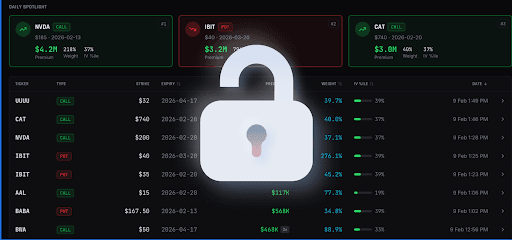
Now I want to hand you the newest trade setups at no cost.
Disclaimer: The profits and performance shown are not based on any sort of typicality for any one individual as there are no live tracked alerts associated with the system. We develop tools and strategies to the best of our ability but no one can guarantee the future. There is always a risk of loss when trading, past performance is not indicative to future results. We make no future earnings claims, and you may lose money. The gains referenced were live options setups based on the Alpha Flow Dashboard signals.