
🚨I’ll be live at 2:30 p.m. ET with Geof Smith🚨
The market is diverging in real time. While United Airlines slashes its forecast as fuel costs explode, the AI profit machine is hitting high gear [tap to join us for Profit Panel]
The other day I watched Netflix (NFLX) gap down while everything else was cruising, and I thought I’d missed a simple short setup.
That gap was clean. The whole market was moving higher, and NFLX just dropped hard. That kind of divergence tends to get my attention, especially when it’s that obvious.
But here’s the thing, I didn’t take it.
Let me walk you through why it looked good, and then why I chose to sit it out.
The Setup That Caught My Eye
I canceled my Netflix subscription, and I’m clearly not alone, because the product doesn’t feel worth what they’re charging anymore.
That realization hit me before the chart ever did, and it’s part of why the sell-off made sense to me in the first place.
It used to justify the price. The original “Narcos” was such a good show. That kind of programming made the monthly bill feel reasonable. But lately, the catalog feels thinner, the quality more inconsistent, and the price keeps creeping up.
When I checked the pricing, I saw about $8.99 for a basic tier, but I remember paying closer to $15 before I cut it. And for what they’re offering now, that premium just didn’t feel earned.
So seeing NFLX fall on a day when everything else was firm didn’t feel random. It lined up with what a lot of consumers are feeling.
The Streaming Math Doesn’t Add Up Anymore
What really drives the point home is how fragmented streaming has become. With cable, you got Disney, Cinemax, Showtime, and HBO under one bill.
No login fatigue. No bouncing between apps trying to remember where a show lives.
Now you’re piecing together four or five subscriptions just to cover the same ground, and suddenly you’re paying more than cable ever cost. The convenience disappeared, the value slipped, and the frustration went up.
The economics don’t favor the consumer anymore, and that usually shows up in churn over time. When people feel like they’re paying more for less, they leave. It’s that simple.
So the short thesis had layers: A technical gap on a quiet market day, weakening product perception, deteriorating consumer sentiment, and a business model under pressure.
But I passed.
I didn’t want to bet on the gap filling, and without that conviction, there was no clean exit plan. A short needs a target, and I didn’t have one I liked.
Sometimes the best trade is the one you don’t take. This was one of those days.
👉 Click here to join Profit Panel at 2:30 p.m. ET on weekdays!
To better trading,
Alex Reid
WealthPin
Follow along and join the conversation for real-time analysis, trade ideas, market insights and more!
- Telegram: https://t.me/+MKMN30kDmVkwMDdh
- YouTube: http://www.youtube.com/@heywealthpin
Important Note: No one from the WealthPin team will ever contact you directly on Telegram.
*This is for informational and educational purposes only. There is inherent risk in trading, so trade at your own risk.
With all the chaos so far in 2026, one highly accurate secret grounded in momentum has called winning market opportunities across different stocks…
I’m talking about a 34% return on Sunrun (RUN) in four days, 81% on Huntsman (HUN) in a day and even 102% on Carnival (CCL) in five days. And this same secret is flagging an opportunity on the next ticker.
Want the name for free?
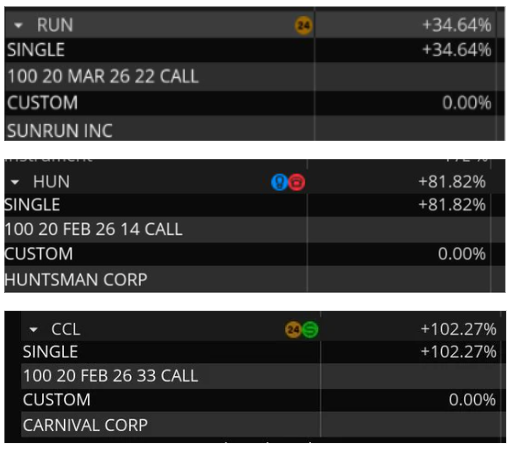
Disclaimer: We develop tools and strategies to the best of our ability, but no one can guarantee the future. The profits and performance shown are not typical to any individual; and you may lose money. From 1/15/25 through 2/4/26, the win rate was 83.7%, with an average winner of 43% and an average net return of 16% for winners and losers over a 5-day average hold time.