
🚨 I’ll be live at 2:30 p.m. ET with Geof Smith🚨
We’ll cover inflation volatility, Geof’s commodity insights, and why the “ending” war is suddenly heating back up [tap to join us for Profit Panel]
The S&P 500 (SPX) gives me structure that single stocks just don’t.
When it comes to selling premium — especially credit spreads — I stick to SPX almost every time. Individual stocks can work, sure, but their risk profile is harder to nail down, and I don’t like guessing.
I spend a lot of time watching charts, sentiment and flows on FinTwit — aka Financial Twitter. Seeing how the crowd reacts reminds me why single names can feel chaotic.
One headline can ripple into a wave, and if you’re selling premium, that unpredictability adds pressure you don’t need.
Take Amazon (AMZN) as an example. I could sell premium on it, but I really don’t know what it’ll do on any given day. Individual names can drift, spike or reverse for reasons unrelated to the broader trend.
That uncertainty adds noise I don’t want when choosing strike placement.
More Liquidity and More Levels to Work With
SPX is different. It’s the broader market, which brings stability. You can identify price levels the market respects consistently.
That structure matters when you’re building income trades that rely on well-defined ranges and predictable behavior.
There’s more to tie your trade to — more liquidity, more participation and more reference points, from moving averages to prior zones where price has reacted.
With SPX, I can anchor my spreads around these areas with confidence. Risk management is easier because I’m not depending on one company to behave.
Take today’s action: While single stocks react to bond auctions or AI spending rumors, SPX is busy respecting its 6,760 support zone.
When I pick strike placement for a spread, I don’t want to fight a $42 billion bond headline — I want to trade the collective consensus of the 500 largest companies in the world.
Structure Over Speculation
That’s the core reason I prefer SPX for premium selling.
It’s not about avoiding individual stocks — it’s about choosing a setup built on stability instead of speculation.
With SPX, I know the behavior patterns, liquidity profile, levels that matter and even the tax and settlement rules.
If you’ve been struggling with single-stock spreads, this broader market foundation can make consistency achievable — and in a strategy where consistency is everything, that’s a huge advantage.
👉 Click here to join Profit Panel at 2:30 p.m. ET on weekdays!
To better trading,
Alex Reid
WealthPin
Follow along and join the conversation for real-time analysis, trade ideas, market insights and more!
- Telegram: https://t.me/+MKMN30kDmVkwMDdh
- YouTube: http://www.youtube.com/@heywealthpin
Important Note: No one from the WealthPin team will ever contact you directly on Telegram.
*This is for informational and educational purposes only. There is inherent risk in trading, so trade at your own risk.
With all the chaos so far in 2026, one highly accurate secret grounded in momentum has called winning market opportunities across different stocks…
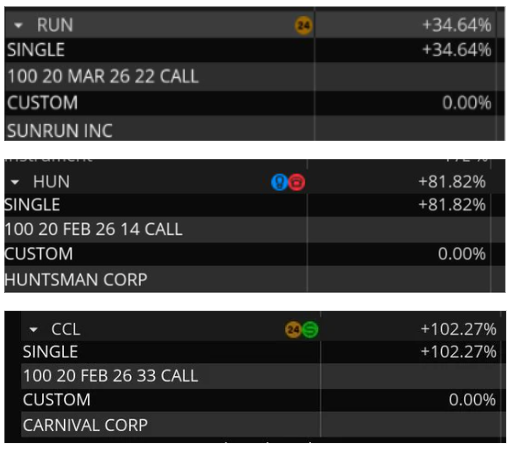
I’m talking about a 34% return on Sunrun (RUN) in four days, 81% on Huntsman (HUN) in a day and even 102% on Carnival (CCL) in five days. And this same secret is flagging an opportunity on the next ticker.
Want the name for free?
Disclaimer: We develop tools and strategies to the best of our ability, but no one can guarantee the future. The profits and performance shown are not typical to any individual; and you may lose money. From 1/15/25 through 2/4/26, the win rate was 83.7%, with an average winner of 43% and an average net return of 16% for winners and losers over a 5-day average hold time.