
🚨 I’ll be live at 2:30 p.m. ET with Geof Smith🚨
I’m officially back from paternity leave and jumping straight into the fire — with oil at $89 and the market pulling back, here’s how we’re trading the chaos [tap to join us for Profit Panel]
Most traders struggle with one critical question: Where exactly should I take profits?
I’ve been working on a technical analysis approach that helps solve that problem by using volume profile data to identify natural resistance zones that align with calculated profit targets.
The concept centers around what I call volume shelves — price levels where significant trading volume has accumulated, creating predictable support or resistance zones.
When your profit target naturally coincides with a volume shelf, you’ve validated both the target’s realism and identified where to expect selling pressure.
The HUN Setup Structure
Let me walk you through a recent analysis on Huntsman (HUN) that perfectly demonstrates this methodology.
While examining the chart, I identified a critical volume shelf that served a dual purpose — both as a resistance zone and a logical profit target.
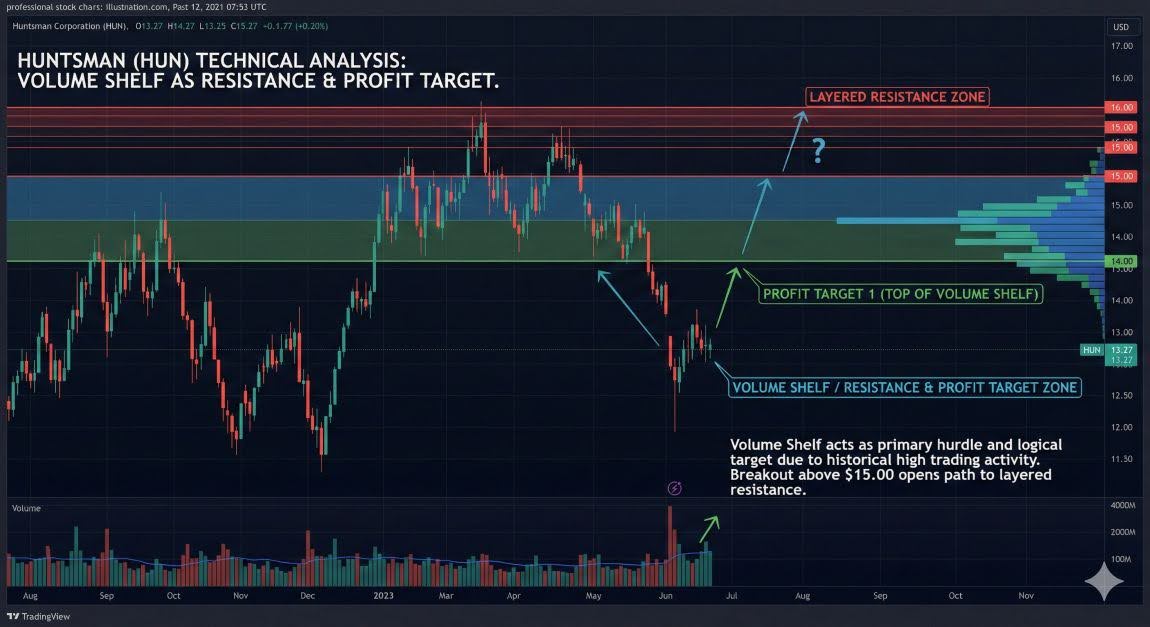
What stood out immediately was that the profit target sat right at the top of the volume shelf. That alignment matters because it confirms the target is realistic and highlights where meaningful resistance is likely to appear.
Even if the stock pushes through the volume shelf, it would likely face resistance at that level. Since that’s where the profit target sits, the trade still works.
The strength of this approach is the layered thinking around resistance. The volume shelf represents the first hurdle. If momentum carries through, there’s room for the stock to run toward the next target.
Risk Management Through Volume Analysis
What makes this methodology powerful is the built-in risk management.
You don’t need perfect execution. Even partial penetration of the volume shelf achieves the objective because that’s where the profit target is set.
That creates a natural buffer — the chart structure does much of the heavy lifting.
The process is straightforward:
- Identify the volume profile
- Locate price levels with heavy historical trading activity
- Mark volume shelves above current price
- Align those levels with profit targets
When those elements line up, you get a trade thesis supported by market structure, not guesswork.
Market conditions matter too.
When capital rotates into safer names or more predictable setups, volume shelves become even more important because they highlight where conviction previously showed up.
👉 Click here to join Profit Panel at 2:30 p.m. ET on weekdays!
To better trading,
Alex Reid
WealthPin
Follow along and join the conversation for real-time analysis, trade ideas, market insights and more!
- Telegram: https://t.me/+MKMN30kDmVkwMDdh
- YouTube: http://www.youtube.com/@heywealthpin
Important Note: No one from the WealthPin team will ever contact you directly on Telegram.
*This is for informational and educational purposes only. There is inherent risk in trading, so trade at your own risk.
With all the chaos so far in 2026, one highly accurate secret grounded in momentum has called winning market opportunities across different stocks…
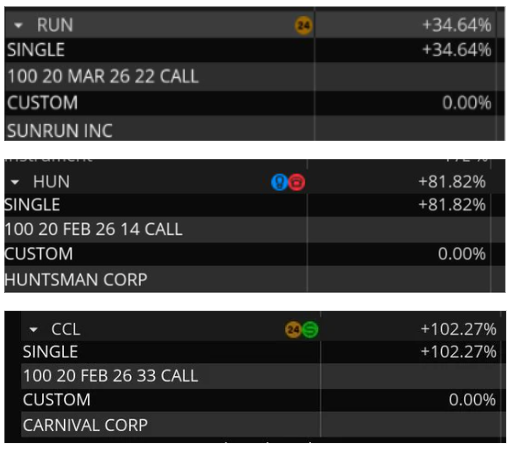
I’m talking about a 34% return on Sunrun (RUN) in four days, 81% on Huntsman (HUN) in a day and even 102% on Carnival (CCL) in five days. And this same secret is flagging an opportunity on the next ticker.
Want the name for free?
Disclaimer: We develop tools and strategies to the best of our ability, but no one can guarantee the future. The profits and performance shown are not typical to any individual; and you may lose money. From 1/15/25 through 2/4/26, the win rate was 83.7%, with an average winner of 43% and an average net return of 16% for winners and losers over a 5-day average hold time.