
1 Signal That Stopped Me from Chasing a Trade

🚨 Profit Panel is live at 9:30 a.m. ET🚨
[tap to join us for Profit Panel]
One of the hardest lessons in trading is learning when not to enter. It sounds simple — wait for a better setup — but when a stock is moving and you have the ticker pulled up, the urge to jump in early can be overwhelming.
Recently, I walked through a live entry decision on LightPath Technologies (LPTH) that shows exactly how I handle that tension.
LPTH had been moving, volume was solid and the chart showed a promising uptrend. But the price action was choppy — it pushed higher, then sold off hard — and the broader market was also under pressure.
When major indexes are selling off and it’s unclear whether the session will offer many quality opportunities, individual stocks can become less predictable. That’s when patience matters most.
Rather than forcing a trade, I wait for the chart to prove that buyers are still in control.
Let the Candlestick Close Before You Commit
When I first started watching LPTH, the candlestick period had about 10 seconds left before it closed.
The pattern was ambiguous. It wasn’t clear whether the selling pressure was finished or if the stock was heading lower.
So I waited. A promising uptrend alone isn’t enough. I also want to see constructive pullbacks, higher lows and support holding after sellers test the price.
Letting the candlestick close helps separate a genuine continuation pattern from a temporary bounce.
This matters because the market is forward-looking. Prices often move before the underlying story becomes obvious, so chasing an early move can mean entering after others have already anticipated it.
Strategic patience gives me a chance to evaluate what the price is confirming instead of reacting to what I hope will happen.
When Support Finally Shows Up
A few minutes later, the price began forming a clearer support line — a level where buyers repeatedly stepped in and held the stock.
Combined with the existing uptrend, that gave me a defined entry and a clear level for recognizing if the setup failed.
I entered the Aug. 21 $15 calls at $0.80, though I tried to get filled at $0.78 for better pricing. The plan was a quick trade that I didn’t want to hold over the weekend.
The setup delivered. The position gained 21%, and I exited with a day trade win.
The difference between chasing the initial spike and waiting for support was the difference between guessing and trading with confirmation.
In uncertain market conditions, your best move is often no move at all.
Let the candlestick close, watch how the price behaves around support and enter only when the chart gives you a plan.
To better trading,
Alex Reid
WealthPin
Follow along and join the conversation for real-time analysis, trade ideas, market insights and more!
- Telegram: https://t.me/+MKMN30kDmVkwMDdh
- YouTube: http://www.youtube.com/@heywealthpin
Important Note: No one from the WealthPin team will ever contact you directly on Telegram.
*This is for informational and educational purposes only. There is inherent risk in trading, so trade at your own risk.
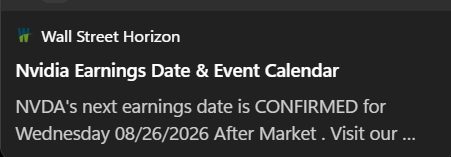
P.S. Where to Focus Ahead of NVDA’s Earnings
Wall Street’s already rotating its cash ahead of the AI giant’s report…
Join in at 4 p.m. ET and you’ll find out what could be the no.1-ranked trade for this week!
Disclaimer: We develop tools and strategies to the best of our ability, but we can’t guarantee the future. Trading always carries a risk of loss. Past Performance is not indicative of future results. What you will see today are some of the best examples from the public trade research service that utilizes this underlying method. From 1/15/25 through 8/17/26, the win rate was 83.1%, with a 39.71% average winner and a 19.52% average net return of winners and losers over a 5-day average hold time.